




HFI / RLHF - SFT Data Generation
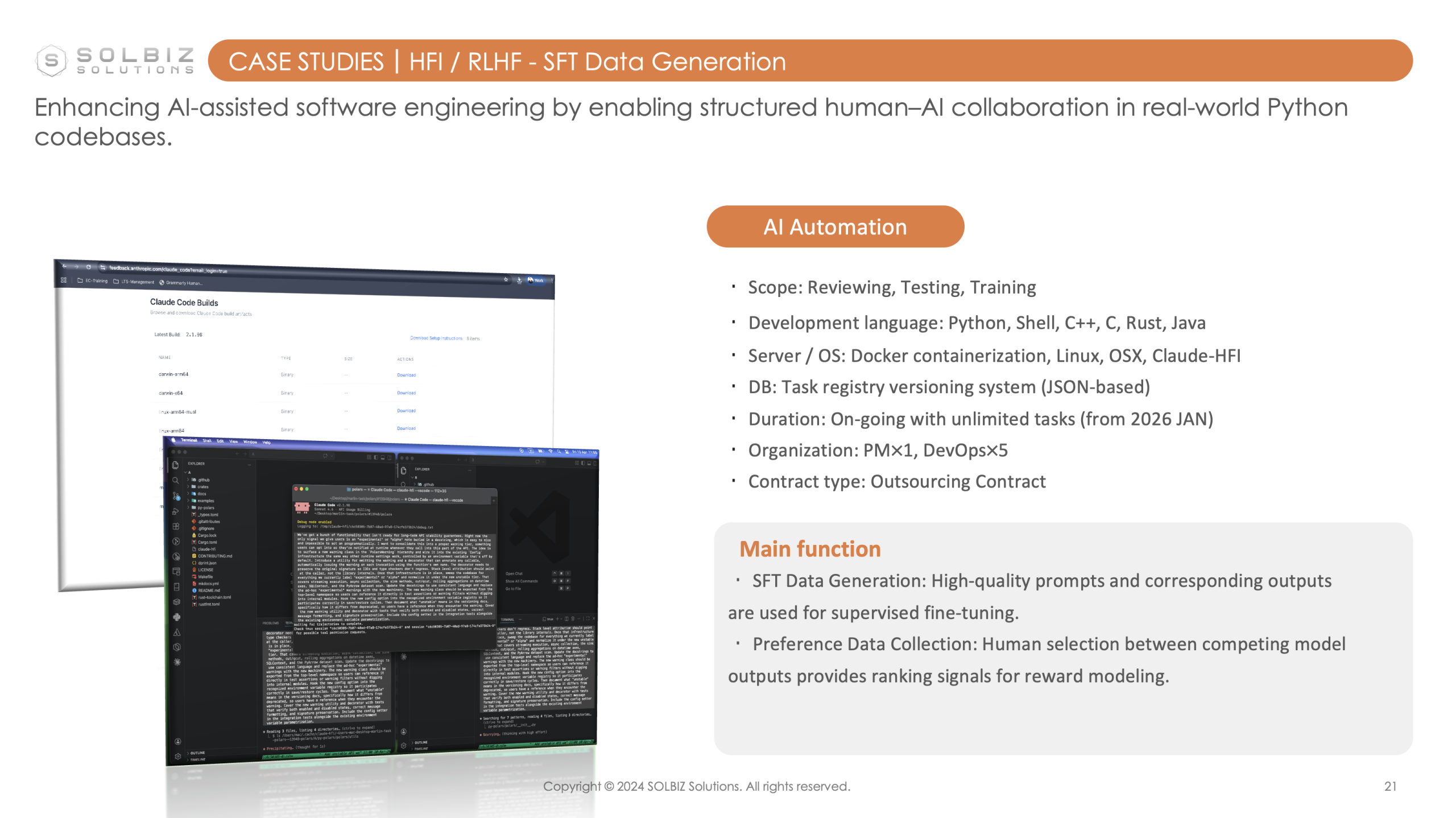
This Project is an initiative aimed at advancing AI-assisted software engineering through structured collaboration between human engineers and state-of-the-art AI models in real-world Python codebases. Unlike traditional automation approaches, the project emphasizes a human-in-the-loop workflow, where developers actively guide, evaluate, and refine AI-generated code to ensure both functional correctness and production-level quality.
Within the project, participants work on real repositories and pull requests, designing high-quality prompts to instruct AI models in performing code modifications, bug fixes, and feature enhancements. The workflow involves running models through CLI-based tools, iterating across multiple response cycles, and critically reviewing outputs to select the most accurate and efficient solutions. This iterative collaboration not only improves immediate development outcomes but also builds a deeper understanding of how to effectively leverage AI in complex engineering environments.
Beyond its practical application in software development, Project Marlin plays a significant role in the Human Feedback for AI (HFI) ecosystem. It contributes directly to the Reinforcement Learning from Human Feedback (RLHF) pipeline by generating two essential types of data: high-quality prompt–response pairs for supervised fine-tuning (SFT), and preference data derived from human evaluation of competing model outputs. These datasets are crucial for continuously improving the reasoning, coding accuracy, and reliability of modern AI systems.
By combining real-world engineering tasks with structured human–AI collaboration, Project Marlin represents a forward-looking approach to software development—where human expertise and machine intelligence work together to deliver scalable, high-quality, and intelligent solutions.